[Fr]
|
[En]
| ||
Né le 23 Août 1849, William Ernest Henley meurt le 11 Juillet 1903 de la tuberculose dont il souffre depuis ses 12 ans.
A l’exception peut-être des aficionados de la littérature anglaise ou la vie de Nelson Mandela, le nom de William Ernest Henley n’évoquera probablement rien au lecteur français, pas même son poème le plus connu : Invictus.
Pour la petite anecdote, en 1875, après l’amputation sous genoux de sa jambe gauche, Henley s’est opposé à l’amputation de sa seconde jambe. Elle sera sauvée par la suite grâce aux soins du chirurgien Joseph Lister.
Le poème est écrit lors de sa convalescence mais ne sera publié qu'en 1888, et comme chacun de ses poèmes, il n’a pas de titre. Il s’agit en fait d’un ajout de l’éditeur Arthur Quiller-Couch lors de la publication de son anthologie de poésie anglaise en 1900 : The Oxford Book of English Verse, 1250-1900.
| Born on August 23rd 1849, William Ernest Henley died on July 11th 1903 of tuberculosis from which he suffered since age 12. With maybe the exception of the aficionados of the English literature or of Nelson Mandela’s life, the name of William Ernest Henley is unlikely to remind anything to a French reader, not even his best known poem: Invictus.
On a side note, in 1875, after the amputation of his left leg below the knee, Henley went against the amputation of his other leg. It was saved later on thanks to the surgeon Joseph Lister.
The poem was written when convalescing but will only be published in 1888, and like any of his poems, it was untitled. The title is actually an addition made by editor Arthur Quiller-Couch with the publication of his anthology of English poetry in 1900: The Oxford Book of English Verse, 1250-1900.
| ||
Invictus - William Ernest Henley (by Alan Bates)
TV-Commercial Series "Poems 1997", which has been broadcasted on CNN.
| |||
En 1883, Henley inspire à son ami Robert Louis Stevenson le personnage de Long John Silver – L’île au trésor.
En 1904, à son tour, Margaret, la fille de Henley morte en 1894 des suites d’une méningite à l’âge de 5 ans, inspire à James Matthew Barrie le personnage de Wendy – Peter Pan, publié sous forme de roman en 1911. Elle l’appelait Fwendy-wendy.
|
In 1883, Henley inspired his friend Robert Louis Stevenson to create the Long John Silver character – Treasure Island.
In turn, in 1904, Margaret, the daughter of Henley deceased in 1894 of meningitis at age 5, inspired James Matthew Barrie to create the Wendy character – Peter Pan, published as a novel in 1911. She used to call him Fwendy-wendy.
| ||
| |||
En 1898 est publiée la première édition d’un recueil regroupant l’ensemble des poèmes de William Ernest Henley : Poems – A Book of Verses – London Voluntaries.
Ce recueil se divise en 5 parties : In Hospital, Bric-à-brac, Echoes, London Voluntaries, Rhymes and Rhythms.
Les 4 poèmes choisis qui suivent sont tous tirés de Echoes. Les traductions françaises me sont toutes propres.
|
In 1898 was published the first edition of a collection gathering all of William Ernest Henley’s poems together: Poems – A Book of Verses – London Voluntaries.
This collection is divided in 5 parts: In Hospital, Bric-à-brac, Echoes, London Voluntaries, Rhymes and Rhythms.
The 4 chosen poems below are all taken from Echoes. The French translations are entirely mine.
| ||
|
| |||
IV ¤ Invictus (1875)
| |||
Du cœur de la nuit qui me drape,
Noire comme l’Abîme d’un pôle à l’autre,
Je remercie les dieux quels qu’ils puissent être
Pour mon âme invulnérable.
Soumis aux cruelles conjonctures
Je n’ai ni grimacé ni ne me suis écrié.
Sous les soufflets de la fortune
Ma tête est ensanglantée, mais haute dressée.
Delà ce lieu d’ire et de larmes,
Ne sourd que l’Horreur de la sombreur,
Et pourtant la menace de l’âge
Ne trouve, et ne trouvera, en moi nulle peur.
Qu’importe l’étroitesse du passage,
Les maints châtiments du parchemin.
Je suis le maître de mon destin :
Je suis le capitaine de mon âme.
|
Out of the night that covers me,
Black as the Pit from pole to pole, I thank whatever gods may be For my unconquerable soul. In the fell clutch of circumstance I have not winced nor cried aloud. Under the bludgeonings of chance My head is bloody, but unbowed. Beyond this place of wrath and tears Looms but the Horror of the shade, And yet the menace of the years Finds, and shall find, me unafraid. It matters not how strait the gate, How charged with punishments the scroll. I am the master of my fate: I am the captain of my soul. | ||
V (1875)
| |||
Je suis la Faucheuse.
Toute chose au crochet aux aguets
Silencieuse il me semble.
Les pâles roses caressées par le printemps,
Les hauts épis de blé en été,
Les fruits riches de l’automne, et les fleurs du frêle hiver –
Faucher, faucher encore –
Toute chose au crochet aux aguets
Opportune il me semble.
Je suis le Semeur.
Toute la vie désincarnée
Passe par ma toile à grains.
L’atome à l’atome marié,
Chacun exaltant l’autre,
Glisse entre mes doigts, toujours différent, toujours identique.
Sans cesse semer,
La vie, l’incorruptible vie,
S’écoule de ma toile à grains.
Créateur et briseur,
Je suis la crue et la décrue,
L’Instant et l’Instant d’Après,
Précipités entre les lacis et les volutes
De l’infinie nature,
Aveugle et silencieux je façonne tout être.
Preneur et donneur,
Je suis le ventre de la mère et la sépulture,
Le Temps Présent et le Sempiternel.
|
I am the Reaper.
All things with heedful hook Silent I gather. Pale roses touched with the spring, Tall corn in summer, Fruits rich with autumn, and frail winter blossoms— Reaping, still reaping— All things with heedful hook Timely I gather. I am the Sower. All the unbodied life Runs through my seed-sheet. Atom with atom wed, Each quickening the other, Fall through my hands, ever changing, still changeless. Ceaselessly sowing, Life, incorruptible life, Flows from my seed-sheet. Maker and breaker, I am the ebb and the flood, Here and Hereafter, Sped through the tangle and coil Of infinite nature, Viewless and soundless I fashion all being. Taker and giver, I am the womb and the grave, The Now and the Ever. | ||
XXIV (1876)
| |||
La vastitude de la mer se déchaîne et tonne
Dans la gloire et l’allégresse.
Ô, m’ensevelissez point dans la terre insensible
Mais dans la mer pétrie de vie !
Ah, ensevelissez-moi là où elle jaillit
A un millier de lieux de la grève,
Et dans son intranquillité fraternelle
Je vagabonderai à jamais.
|
The full sea rolls and thunders
In glory and in glee.
O, bury me not in the senseless earth
But in the living sea!
Ay, bury me where it surges
A thousand miles from shore,
And in its brotherly unrest
I’ll range for evermore.
| ||
XXXI (1877)
| |||
Ô, avez-vous béni, au-delà des astres,
L’éclat bleuté dans les cieux,
Quand Juin les roses autour d’elle s’exclame ? —
Discernez-vous alors la lueur qui choit
De ses bien-aimés yeux.
Et avez-vous éprouvé ce sentiment de paix
Que procurent les matutinales prairies ? —
Discernez-vous alors l’esprit de grâce,
L’ange indulgent sur son visage,
Qui rend agréable la vie.
Elle brille devant moi, rêve et espoir,
Si belle, si calme, si sage,
Que, la conquérant, je semble conquérir
Delà la terre et le travail et le tapage,
Un bout de Paradis.
|
O, have you blessed, behind the stars,
The blue sheen in the skies,
When June the roses round her calls?—
Then do you know the light that falls
From her belovèd eyes.
And have you felt the sense of peace
That morning meadows give?—
Then do you know the spirit of grace, The angel abiding in her face,
Who makes it good to live.
She shines before me, hope and dream,
So fair, so still, so wise,
That, winning her, I seem to win Out of the dust and drive and din
A nook of Paradise.
| ||

Affichage des articles dont le libellé est translation. Afficher tous les articles
Affichage des articles dont le libellé est translation. Afficher tous les articles
8 avr. 2015
[Fr] Invictus et autres poèmes de W. E. Henley ¤ [En] Invictus and Other Poems of W. E. Henley


28 janv. 2015
[Fr] 6 poèmes choisis d'Emily Dickinson ¤ [En] 6 Chosen Poems Of Emily Dickinson
[Fr]
|
[En]
| ||
Pour faire bref, Emily Elizabeth Dickinson, dite Emily Dickinson, est
l’une des poétesses américaines les plus connues du 19ème siècle et a pour
ainsi dire vécu toute sa vie à Amherst, Massachusetts (10 décembre 1830 –
15 mai 1886). Cadette d’une fratrie de trois, si elle répugnait à
recevoir qui que ce soit cela ne l’empêchait pas d’entretenir des amitiés par
correspondance.
Pour la petite anecdote, outre son penchant pour les vêtements
blancs, Emily Dickinson n’avait publié que très peu de poèmes de son vivant,
moins d’une douzaine sur près de mille huit cents, autant dire une broutille.
|
To keep it short,
Emily Elizabeth Dickinson, known as Emily Dickinson, is one of the most
famous American poetesses of the 19th century and lived her whole life as it
were in Amherst, Massachusetts (December 10, 1830 – May 15, 1886). Second of three siblings, if she was reluctant to receive anyone it didn’t
prevent her from carrying out friendships by correspondence.
On a side note,
besides her having a liking for white clothing, Emily Dickinson only ever
published but a few of her poems in her lifetime, less than a dozen out of nearly a
thousand and eight hundreds poems, that is to say a mere trifle.
| ||
| |||
Si dès 1890, parties de son œuvre furent publiées par deux de ses
connaissances – Thomas Wentworth Higginson (1823 – 1911), son mentor et
Mabel Loomis Todd (1856 – 1932) – ses poèmes ont été largement modifiés voire
réécrits pour correspondre aux standards de ponctuation et de majuscule de la fin 19ème siècle.
Entre 1914 et 1945, Martha Dickinson Bianchi (1866-1943) a publié
plusieurs recueils en s’appuyant sur les manuscrits de sa tante conservés par
sa famille, tandis que Millicent Todd Bingham (1880-1968) elle s’est basée
sur les manuscrits par sa mère Mabel Loomis Todd. Cependant, les poèmes sont
encore largement modifiés.
Grâce à un travail rigoureux de Thomas Herbert Johnson, c’est en 1955
que fut publiée une première édition complète et rigoureuse en trois volumes
des poèmes d’Emily Dickinson : The Poems of Emily Dickinson (1775
poèmes).
Les poèmes sont quasiment sous leur forme originale et conservent
ainsi les spécificités propre à la poétesse : tirets, majuscules
irrégulières, style souvent extrêmement elliptique. Ils n’ont pas de titre et
sont numérotés selon un ordre chronologique approximatif. Il reste toutefois
quelques traces des modifications apportées par Todd et Higginson.
C’est enfin en 1998 que Ralph W. Franklin a publié l’édition la plus
complète en trois volumes également de l’œuvre d’Emily Dickinson : The Poems of Emily Dickinson, Variorum Edition (1789 poèmes).
Les poèmes sont sous leur forme originale, retranscrits via
fac-similés et numérotés suivant leur ordre chronologique.
|
If from 1890, parts
of her works were published by two acquaintances of hers – Thomas Wentworth
Higginson (1823 – 1911), her mentor and Mabel Loomis Todd (1856 – 1932) – her
poems were extensively edited if not rewritten in order to match the
punctuation and capitalization standards of the late 19th century.
Between 1914 and
1945, Martha Dickinson Bianchi (1866-1943) published many collections based on the manuscripts of her aunt kept by her family, whereas Millicent Todd Bingham (1880-1968)
based her collections on the manuscripts kept by her mother Mabel Loomis
Todd. However, the poems are still extensively edited.
Thanks to a
scholarly work of Thomas Herbert Johnson, the first complete and thorough
three-volume edition of Emily Dickinson’s poems was published in 1955: The Poems of Emily Dickinson (1775 poems).
The poems were
nearly in their original form and therefore held the peculiar specificities
of the poetess: dashes, irregularly capitalizations, often extremely
elliptical style. They have no title and are numbered in an approximate
chronological order. Yet, traces of the edited version of Todd and Higginson
still remain.
It’s finally in 1998
that Ralph W. Franklin published the most complete edition of Emily
Dickinson’s work, also a three-volume edition: The Poems of Emily Dickinson, Variorum Edition (1789 poems).
The poems are in
their original form, transcribed from facsimiles and numbered according to
their chronological order.
| ||
Voici six poèmes choisis d’Emily Dickinson, chacun est précédé de la
numérotation de Franklin, l’année établie par Franklin et de la numérotation
de Johnson. Ils ont tous été écrits à Amhrest, Massachusetts.
La traduction française m'est entièrement propre, je n'ai lu aucune des traductions déjà existantes. |
Here are six chosen poems
of Emily Dickinson’s, each preceded by the Franklin numbering, the year
established by Franklin and the Johnson numbering. All of them were written
in Amhrest, Massachusetts.
The French translation is entirely mine, I have read none of the already existing translations. | ||
| |||
Fr20, 1858 (J29)
| |||
Si ceux que j’aimais étaient perdus
La voix du Crieur m’alerterait —
Si ceux que j’aimais étaient retrouvés
Les cloches de Gand sonneraient —
Ceux que j’aimais seraient-ils au repos
La Pâquerette m’orienterait.
Philippe — alors que troublé
Avec lui son mystère emportait !
|
If those I loved
were lost
The Crier's voice would tell me— If those I loved were found The bells of Ghent would ring— Did those I loved repose The Daisy would impel me. Philip—when bewildered Bore his riddle in! | ||
Fr137, 1860 (J74)
| |||
Une Dame rouge — au milieu de la Colline
Son secret annuel conserve !
Une Dame blanche, au sein du Champs
Dans un Lys placide sommeille !
Les Brises ordonnées, avec leurs Genêts—
Balayent val — colline — arbre!
Fi donc, Mes belles Compagnes !
Quel attendu ce peut-il être ?
Les voisins n’ont encore nul soupçon !
Les bois échangent un sourire !
Verger, Bouton d’Or, Oiseau —
En un moment si réduit !
Pourtant, quelle paix sur le Paysage règne !
Quelle nonchalance sur la Haie !
Comme si la « Résurrection »
N’était rien de très extraordinaire !
|
A Lady red—amid the
Hill
Her annual secret
keeps!
A Lady white, within
the Field
In placid Lily
sleeps!
The tidy Breezes,
with their Brooms—
Sweep vale—and
hill—and tree!
Prithee, My pretty
Housewives!
Who may expected be?
The neighbors do not
yet suspect!
The woods exchange a
smile!
Orchard, and
Buttercup, and Bird—
In such a little
while!
And yet, how still
the Landscape stands!
How nonchalant the
Hedge!
As if the
"Resurrection"
Were nothing very
strange!
| ||
Fr233, 1861 (J204)
| |||
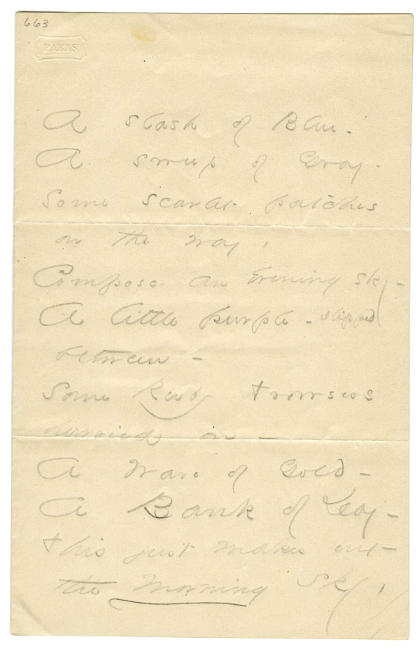
Balafre de Bleu ! Étendue de Gris !
Quelques macules écarlates — de passage —
Composent un Ciel à la Tombée du Jour —
Une pointe de pourpre — immiscée çà et là —
Quelques Pantalons Garance — empressés —
Vague d’Or — Berge d’une Journée —
Ceci forme juste le Ciel à la Pointe du Jour !
|
A slash of Blue! A
sweep of Gray!
Some scarlet patches
— on the way —
Compose an Evening
Sky —
A little purple —
slipped between —
Some Ruby Trousers — hurried on —
A Wave of Gold — A
Bank of Day —
This just makes out
the Morning Sky!
| ||
Fr278, 1862 (J1212)
| |||
Un mot périt une fois dit
D’aucuns disent —
Je dis que sa vie a tout juste commencé
Ce jour-là.
|
A word is dead when
it is said
Some say —
I say it just begins to live That day. | ||
Fr579, 1863 (J683)
| |||
L’Âme envers elle-même
Est une impériale amie —
Ou l’Espion le plus moribond —
Que pourrait envoyer — un Ennemi —
Prémunie contre la sienne —
Nulle traîtrise elle ne saurait craindre —
Elle-même — sa Souveraine — Face à elle-même
L’Âme doit faire montre de Révérence —
|
The Soul unto itself
Is an imperial friend — Or the most agonizing Spy — An Enemy — could send — Secure against its own — No treason it can fear — Itself — its Sovereign — Of itself The Soul should stand in Awe — | ||
Fr1109, 1866 (J1079)
| |||
Le Soleil descendit — nul Homme regarda —
La Terre et Moi, seules,
Étions présentes à la Majesté —
Il triompha, et s’en alla —
Le Soleil s’éleva — nul Homme regarda —
La Terre et Moi et Unique
Un Oiseau sans nom — un Etranger
Furent les Témoins de la Couronne —
|
The Sun went down —
no Man looked on —
The Earth and I, alone, Were present at the Majesty — He triumphed, and went on — The Sun went up — no Man looked on — The Earth and I and One A nameless Bird — a Stranger Were Witness for the Crown — | ||
 | |||


.png)
Further readings:
5 nov. 2014
[Fr] L'acte de traduction, la randonnée d'un artisan des mots ¤ [En] The Act of Translation, a Wordsmith Hike
 |
| 2013-07 28 ¤ Path Shadow |
[Fr]
|
[En]
|
On se lance dans une traduction comme on part en
randonnée – préparé !
On repère le terrain. On détermine le but à
atteindre. On doit être en forme. On s’arme de bonnes chaussures de marche, d’un
bâton de marche (ou pas) et d’un sac-à-dos chargé du nécessaire :
|
One
embarks on a translation as they would a hiking – prepared!
You
get some field recon carried out. You determine a goal to reach. You have to
be in good shape. You get yourself equipped with fitting hiking boots, hiking
stick (or not) and a backpack loaded with necessities:
|
Le terrain, c’est le livre, l’histoire à traduire. Il faut en repérer
les difficultés, les pièges, les ravins et se méfier des faux-plats.
Si pour le randonneur le but à atteindre est d’aller du point A au
point B, celui du traducteur est de capturer l’essence d’un livre écrite dans
une langue source et de la transcrire dans une langue cible, de faire ressentir aux lecteurs de la langue
cible les émotions que le traducteur a lui-même ressenti lors de sa lecture
dans la langue source.
Tout comme le randonneur se repère et se dirige grâce à la carte et à
la boussole, la connaissance de la langue source et le contexte permettent au
traducteur de s’atteler à la tache. La première nous évite de tomber dans les
écueils et nous permet de déchiffrer les subtilités. Le second sert de fil d’Ariane,
il s’agit du contexte et de la poétique de l’auteur – le vocabulaire, la syntaxe, les idiosyncrasies, le sel culturel.
|
The field is the
book, the story to be translated. You have to identify its difficulties, its
traps, its gullies and to be wary of its false flats.
If the hiker’s goal
to reach is to go from point A to point B, the translator’s one is to capture
the essence of a book written in a source language and to transcribe it, to make
the target-language-speaking readers feel the emotions the translator felt
themselves during their reading in the source language.
Just like the hiker
spots their location and finds their way thanks to the map and compass, the
command of the source language and context allow the translator to tackle
their task. The former prevents you from falling into pitfalls and enables
you to decipher the subtleties. The latter serves as Ariadne’s thread, it’s
about context and the
author’s poetic licence – vocabulary, syntax, idiosyncrasies, cultural
flavor.
|
A fortiori lors d’une marche en solo, le randonneur doit s’assurer d’être
en bonne condition physique, d’avoir les chaussures adéquates et pourquoi pas
un bâton de marche.
Il en va de même pour le traducteur : il entretient sa maîtrise
de la langue cible (c’est-à-dire sa langue maternelle), il s’équipe de
dictionnaires et parfois d’autres outils linguistiques pour assurer sa
progression.
|
Even more so if they’re
going solo, the hiker has to make sure they are in good shape, they wear fitting
footwear and why not a hiking stick.
It also applies to
the translator: they have to maintain their command of the target language (namely
their mother tongue), to gear up with dictionaries and sometimes with other linguistic
tools in order to insure their progression.
|
Ensuite, vient la préparation du sac-à-dos, à commencer par l’essentiel
au bien-être du randonneur : l’eau, le casse-croûte, le couchage, une
trousse de toilette et des vêtements.
Comme tout être humain, randonneur et
traducteur doivent s’hydrater, se sustenter, faire des pauses, prendre soin
de soi et se changer.
Dans le sac-à-dos du randonneur se trouvera également du cordage, un couteau
de survie, un briquet, un lampe torche et ses piles de rechange, de quoi se
protéger du froid et du soleil, sans oublier la trousse de secours en cas de
pépin.
En cas de difficulté, le traducteur lui sera armé de ses procéder de
traduction : l’adaptation, l’emprunt, le calque, la compensation, la
paraphrase et la note de traduction. Et si vraiment ça coince, que l’on trébuche
ou que l’on a un doute, sauf exception,
l’auteur sera ravi d’éclairer nos lanternes, alors pourquoi hésiter à
|
Then comes the
preparation of the backpack, starting with the essential to the hiker’s
well-being: water, snacks, sleeping bag, toilet kit and clothes.
Just like any other
human being, hiker and translator have to keep hydrating, feed, take breaks,
take care of themselves and change.
Inside a hiker’s
backpack, you’ll also find rope, survival knife, lighter, flashlight and spare batteries, protective
gear against the cold and the sun, not forgetting the first-aid kit in case
of mishap.
As for the
translator, should there be a problem, they’ll arm themselves with
translation procedures: adaptation, borrowing, calque, compensation,
paraphrase and translator’s note. And if really there is a hitch, you stumble
or you have a doubt about something, exception aside, the author will be delighted
to provide us with enlightenment, so why not
|
10 oct. 2014
[Fr] Le Corbeau d'E.A. Poe ¤ [En] The Raven by E.A. Poe
[Fr]
|
[En]
|
Rien que pour le plaisir et anecdotiquement parce que le 7 octobre
dernier était le 165ème anniversaire de la mort d’Edgar Allan Poe,
voici ma traduction des deux premières strophes du plus célèbre de ses
poèmes.
N’en déplaise à William Little Hughes (1862 ?), Charles Baudelaire
(1865), Stéphane Mallarmé (1875) et Maurice Rollinat (1926) pour leur
traduction.
|
Just for fun and on a side note because the last 7th of October was the 165th
anniversary of Edgar Allan Poe’s passing, here is the first two stanzas of
his most famous poem.
With all due respect
to William Little Hughes (1862?), Charles Baudelaire (1865), Stéphane Mallarmé
(1875) and Maurice Rollinat (1926) for their translation.
|
Once upon a midnight dreary, while I pondered, weak and weary, Par une mi-nuit funeste, alors que je méditais, faible et fatigué, | |

28 sept. 2014
[Fr] Catch-22 quésaco ? ¤ [En] Catch-22 whatzis?
[Fr]
|
[En]
|
||
That’s a real Catch-22.
Chose curieuse, une fois que vous tombez sur une expression typique, propre
à une culture, elle ne cesse d’apparaître ici et là les jours qui suivent.
Catch-22 fait partie de ces expressions issues d’un
film ou d’un roman populaire qui deviennent idiomatiques et font la richesse
d’une culture.
|
That’s a real Catch-22.
Funny thing is, once you stumble upon a typical expression, specific
to a culture, it never stops popping up here and there throughout the
following days.
Catch-22 is one of those expressions taken from a popular movie or
novel that turn into colloquialisms and make the wealth of a culture.
|
||
|
|||
I ¤ Origine
Livre culte des pacifistes opposés à la guerre du Viêt Nam, ce roman
satirique met en scène une escadron d’aviateurs au cours de la Seconde Guerre
Mondiale – dont le héros tragi-comique : John Yossarian, Capitaine de
l’US Air Force et navigateur-bombardier de B-25 – basée sur la petite île
italienne de Pianosa.
Catch-22 fait référence à l’article 22 du règlement de la base de l'US Air Force:
Quiconque veut être dispensé d'aller au feu n'est pas complètement fou.
|
I ¤ Origin
Cult book of the anti-Vietnam-War pacifists, this satirical novel
stages a squadron of pilots during the Second World War – among them the
tragic-comic hero: John Yossarian, US Air Force Captain and B-25 bombardier –
stationed on the small Italian island Pianosa.
Catch-22 refers to point 22 of the US Air Force base regulations: Anyone who wants to get out of
combat duty isn't really crazy.
|
||
|
|||
II ¤ La source
Voici un extrait du Chapitre 5 du
roman de Joseph Heller où la notion est explicitée :
Yossorian le considéra posément et tenta une autre approche : « Orr est-il cinglé ? |
II ¤ The source
Here is an excerpt from Chapter 5 of Joseph Heller’s novel in which the notion is made plain obvious:
Yossarian looked at him soberly and tried another approach. "Is Orr crazy?" |
||
III ¤ La logique d'un 'Catch-22'
La formulation logique de la situation peut être décrite comme
suit :
Pour qu'un individu soit dispensé de vol (D) au motif de la folie, il doit à la fois être fou (F) et demander à être évalué (E). #2 Prédicat (F ® ¬E) : Un individu fou (F) ne demande pas à être évalué (¬E) parce qu'il n'a pas conscience d'être fou. #3 Implication de #2 (¬F Ú ¬E) : Soit l'individu n'est pas fou (¬F), soit il ne demande pas être évalué (¬E) #4 Règles d'algèbre booléennes appliquées à #3 (¬(F Ù E)) : Aucun individu ne peut à la fois être fou (F) et demandé à être évalué (E). #5 Déduction faite de #1 et #4 (¬D) : Donc, aucun individu ne peut être dispensé de vol (¬D) puisqu'aucun individu ne peut à la fois être fou et demandé à être évalué. |
III ¤ The logic of a 'Catch-22'
The logical formulation of the situation can be seen as such:
For a person to be excused from flying (E) on the grounds of insanity, they must both be insane (I) and have requested an evaluation (R). #2 Premise (I ® ¬R): An insane person (I) does not request an evaluation (¬R) because they do not realize they are insane. #3 Implication of #2 (¬I Ú ¬R): Every person is either not insane (¬I) or does not request an evaluation (¬R). #4 Boolean algebra laws applied to #3 (¬(I Ù R)): No person can be both insane (I) and request an evaluation (R). #5 By inference from #1 and #4 (¬E): Therefore, no person can be excused from flying (¬E) because no person can be both insane and have requested an evaluation. |
||
|
|||
IV ¤ La notion
Le roman de Joseph Heller a eu un tel succès à l’époque de sa
parution que le titre Catch-22 est très vite passé dans le
langage courant américain.
Que ce soit le Cambridge Dictionary, leLongman Dictionary of Contemporary English ou le MacMillan Dictionary, l’expression Catch-22 est défini par une situation impossible
où vous êtes dans l’incapacité de faire une chose à moins d’en avoir faite
une autre que vous ne pouvez pas faire tant que la première n’a pas été
faite.
Définition qui correspond à la situation vécue par les héros du roman.
Le Merriam-Webster et
le Collins apportent
une définition alternative en plus de la définition initiale. L’expression Catch-22 est défini par une situation présentant deux alternatives
aussi indésirable l’une que l’autre – en d’autres termes une situation
inextricable, une situation sans issue ou tout simplement, une situation
perdant-perdant.
Cette définition fait l’impasse sur le lien d’exclusion mutuelle qui
existe entre chaque alternative.
Seul le Merriam-Webster apporte en complément des définitions
simplifiées de Catch-22. L’expression décrit une situation illogique, absurde
ou insensée (soit une situation ubuesque), une mesure ou règle
dont l’effet est contraire à celui escompté ou une difficulté
cachée ou une manière de tendre un piège (soit une entourloupe ou une embuscade).
L’expression est souvent employée à mauvais escient et caractérise
ces définitions simplifiées données par le Merriam-Webster et
le Collins.
A tel point que pour insister sur le fait que l’on l’emploie pour
caractériser son sens premier, l’expression devient a real Catch-22.
|
IV ¤ The notion
Joseph Heller’s novel was such a success at the time it came out that
the title Catch-22 quite soon became part of the American everyday speech.
Whether it be the Cambridge Dictionary, the Longman Dictionary of Contemporary English or the MacMillan Dictionary, the colloquialism Catch-22 is defined as
an impossible situation where you
are prevented from doing one thing until you have done another
thing that you cannot do until you have done the first thing.
Definition in accordance with the situation experienced by the heroes
of the novel.
The Merriam-Webster and the Collins provide an
alternative definition on top of the original one. The colloquialism Catch-22 is
defined as a situation presenting two equally undesirable alternatives – in
other words an impossible position, a dead-end or simply a lose-lose
situation.
This definition misses out the link of mutual exclusion existing
between both alternatives
Only the Merriam-Webster provides complementary simplified
definitions of Catch-22. The colloquialism describes an illogical,
unreasonable, or senseless situation (that is to say an Ubuesque situation),
a measure or policy whose effect is the opposite of what was intended or a hidden difficulty or means of entrapment (that is to say a catch or an
ambush).
The colloquialism often is unwisely used and characterizes those
simplified definitions given by the Merriam-Webster
and the Collins.
So much so that in order to underline the fact that it is used to
characterize its primary sense, the colloquialism becomes a real Catch-22.
|
||
V ¤ Traductions française existantes et remarques
En 1964, de part la traduction même du roman de Joseph Heller par Pierre Singer, a
catch-22 est un attrape-nigaud.
Un attrape-nigaud est une ruse grossière et se traduit par confidence
trick.
Or, par principe, la traduction d’un néologisme par un terme ou une
expression du langage courant me paraît inadéquate.
En 1986, l’Office Québécois de la Langue Française privilégie les termes impasse, situation sans issue et cercle vicieux. Chacun de ces termes ont des
équivalents anglais : respectivement impasse, dead-end et vicious circle.
Si les deux premiers termes correspondent aux définitions simplifiées de
l’expression Catch-22, le troisième lui correspond à un ensemble de causes et
d’effets qui dégradent une situation.
Or une situation qui se dégrade n’est pas, par définition, une situation impossible.
Pour le Larousse,
il s’agit d’une situation sans issue ou d’un cercle vicieux.
Pour le Collins,
il s’agit d’une situation inextricable.
De la même manière, le terme correspond à l’une des définitions
simplifiées de l’expression et possède son équivalent anglais :
impossible position.
|
V ¤ Existing French translations & remarks
In 1964, because of the very translation of Joseph Heller's novel by Pierre Singer, a catch 22 is un attrape-nigaud.
Un attrape-nigaud is a cheap trick and is translated by confidence trick. Now, out of principle, translating a neologism by a term or an expression of the common language seems inappropriate to me. In 1986, the Office Québécois de la Langue Française favoured the terms impasse, situation sans issue and cercle vicieux. Each of these terms has an English equivalent: respectively, impasse, dead-end and vicious circle. If the first two terms correspond to the simplified definitions of the colloquialism Catch-22, the third corresponds instead to a series of causes and effects that gradually damages a situation. However a situation that is gradually damaged is not, by definition, an impossible situation. According to the Larousse, it is about une situation sans issue or un cercle vicieux. According to the Collins, it is about une situation inextricable. Similarily, the term corresponds to one of the simplified definitions of the colloquialism and has its English equivalent: impossible position. |
||
VI ¤ Réflexions et proposition
La première traduction française du roman de Pierre Singer date de
1964 et la seconde, de Brice Matthieussent, de 2004. Le roman de Joseph
Heller a eu un tel succès à l’époque de sa parution en 1961 que Catch-22 est très vite passée dans le langage courant
américain. Que la traduction sorte 3 ou 43 ans après l’original, la question
reste la même : traduire ou ne pas traduire le titre ?
Si on parle d’article pour une loi, on parle de point ou de clause
pour un règlement particulier (d'une base militaire ou non).
Si article et point ont une connotation
pour le moins neutre et évoquent quelque chose de carré, il en va tout
autrement pour clause. Dans l’inconscient collectif français, la clause
fait penser à cette note de bas de page qui passe généralement inaperçue, une
condition de derrière les fagots qui ne penche
généralement pas en notre faveur. Clause a donc une
connotation plutôt négative.
Dans le cas du roman de Joseph Heller, le point 22 du règlement de la base de l'USAF est
une condition bien particulière : une condition qui autorise au commandement
de la base de faire tout ce qui ne peut lui être empêché (Chapitre 39) et dont
on ne peut prouver si elle existe vraiment puisque personne ne l’a jamais lue et que
personne n’est autorisé à la lire de par le point 22 (Chapitre 40).
Son but est d’interdire à un soldat de faire ou d’obtenir ce qu’il
serait en droit de faire ou d’obtenir.
Le point 22 n’est donc pas tant un point de règlement de la base qu’une
condition de derrière les fagots du genre de ces notes de bas de page. On
appellera donc le point 22 la clause 22.
|
VI ¤ Reflections & proposition
The first French translation of the novel by Pierre Singer dates from 1964 and the second, by Brice Matthieussent, dates from 2004. Joseph Heller's novel was such a hit at the time of its publication in 1961 that the Catch-22 very soon passed into the common American language. Whether the translation be published 3 or 43 years after the original, the question remains the same: should the title be translated or not?
If you talk about an article of law, you talk about a point or a clause of specific regulations (milirary or not). If article and point have a rather neutral connotation and evoke something straightforward, the same certainly cannot be said for clause. In French collective unconscious, the clause calls this footnote that generally goes unnoticed to mind, a condition from under the counter that generally doesn't tip the scale in our favour. Clause hence has a rather negatvie connotation. In the case of Joseph Heller's novel, le point 22 is quite a special condition of the USAF base regulations: a condition that allows base command to do anything they can't be stopped from doing (Chapter 39) and of which very existence can't bo proved since noone ever read it and noone is allowed to read it because of le point 22 (Chapter 40). Its aim is to forbid a soldier to do or obtain what they should have the right to do or obtain. Then le point 22 isn't so much un point of the base regulations as a condition from under the counter of the footnote kind. Le point 22 will then be called la clause 22. |
||
Puisque Catch-22 fait référence au point 22 du règlement de la base, l’idée de traduire le terme catch en utilisant le
jargon militaire français semblerait acceptable. Le terme piège à cons s’impose alors.
L’inconvénient de cette option réside dans la disparité entre les registres de langue de la langue source (familier) et de la langue cible
(argot).
Littéralement, et dans le contexte du roman, a catch est une
difficulté dissimulée ou un obstacle, ce qui se traduirait par une
entourloupe – mauvaise plaisanterie, propos fantaisistes ou mauvais tour
destinés à duper quelqu'un, irrégularité – ou un hic – point délicat
ou obstacle majeur. Le registre de langue des langues source et cible sont identiques
(familier).
Cependant, de par le roman lui-même, a catch-22 est un terme qui
suggère un obstacle majeur plutôt qu’une mauvaise plaisanterie. La clause n’est
en aucun cas un jeu et n’a pas vocation à être drôle; même si l’absurdité des
situations peut prêter à rire jaune. Et la clause est d’autant moins une
irrégularité qu’elle fait partie du règlement de la base, que l’existence même de cette
clause soit avérée ou non.
Traduire a catch par un hic semble alors le plus judicieux.
Autre élément qui penche vers cette solution : en anglais
américain, un hic se dit a snag et se définit par un point délicat / un
obstacle inattendu ou dissimulé.
|
Since Catch-22 refers to the point 22 of the base regulations, the idea of translating the term catch by using the French military jargon would seem acceptable. Then the term piège à cons is self-evident.
The disadvantage of this option is the language register discrepancy between the source language (informal) and the target language (slang). Literally, and in accordance with the context of the novel, a catch is a hidden difficulty or an obstacle, which could be translated by une entourloupe – a jibe, fanciful words or a dirty trick meant for duping someone, an irregularity – or un hic – a tricky point or a major obstacle. The language register is the same for both the source language and the target language (informal). However, because of the novel itself, a catch-22 is a term that suggests a major obstacle rather than a dirty trick. The point isn't by any means a game nor is it meant to be funny; even though the absurdity of the situations can give rise to sour laughter. And the point is even less so an irregularity given that it is part of the base regulations, whether its very existence be proven or not. Then translating a catch by un hic seems to be the wisest. Another element in favour of this solution: in American English, un hic is a snag and is defined as an unexpected or hidden tricky point / obstacle. |
||
Toutefois, si dans That's some catch, that Catch-22! la
répétition de catch passe très bien en anglais, son calque en français Ça, c’est du hic, ce Hic-22 ! ne passe pas du tout, contrairement
à l’adaptation Ça, c’est du hic, cette Clause 22 !
Forger un mot ne se fait pas aussi facilement en français qu’en
anglais.
Voltaire disait :
N'employez jamais un mot nouveau, à moins qu'il n'ait ces trois qualités : d'être nécessaire, intelligible, et sonore. Des idées nouvelles, surtout en physique, exigent des expressions nouvelles ; mais substituer à un mot d'usage un autre mot qui n'a que le mérite de la nouveauté, ce n'est pas enrichir la langue, c'est la gâter.
En l’occurrence, si en anglais on comprend aisément que Catch-22 est le nom donné à un point de règlement de la base, le calque Hic-22 empeste la traduction
or l’art de la traduction est quand même de passer inaperçue aux yeux du
lecteur.
Il est donc plus judicieux de traduire a catch par un hic mais de
traduire Catch-22 par ce que cela représente concrètement, c’est-à-dire la Clause
22.
|
Nevertheless, if in That's some catch, that Catch-22! the repetition of catch goes quite smoothly in English, its calque in French Ça, c’est du hic, ce Hic-22 ! not so much, unlike the adaptation Ça, c’est du hic, cette Clause 22 !
Coining a word isn't as easily done in French as it is in English. Voltaire stated: Do not ever use a new word, unless it has these three qualities: to be necessary, intelligible and resounding. New ideas, especially in Physics, demand new expressions; but to substitute a common word for another word that has no other virtue than of novelty, it isn't increasing the wealth of a language, it's spoiling it.As it happens, if in English it is quite clear that Catch-22 stands as the given name of a point of the base regulations, the claque Hic-22 reeks of translation, yet the very art of translating consists in going unnoticed in the reader's eyes. So it is wiser to translate a catch by un hic but to translate Catch-22 by what it stands for in concrete terms, that is to say la Clause 22. |
||
|
|||
VII ¤ Traduction du titre
Le titre est important par essence : court ou long, il donne le
ton, il intrigue, il suggère quelque chose, il donne envie au lecteur de le lire ou non.
Si l’auteur choisit un titre, il y a une raison. La décision de
traduire ou non le titre ne peut se faire qu’après lecture du roman.
Pierre Singer a choisi en 1964 de traduire le titre du roman de
Joseph Heller par L’attrape-nigaud. Un attrape-nigaud est par définition une
ruse grossière, ce qui va à l’encontre de la subtilité sournoise de la Clause
22.
En outre, le titre choisi par Pierre Singer fait l’impasse sur
la spécificité du titre original.
Avec Catch-22, le titre original suggère le point 22 d’un règlement
ET un ‘attrape-nigaud’, ce qui n’est pas le cas avec le titre de Pierre
Singer où il manque le second élément.
A l’inverse, en 2004 Brice Matthieussent a choisi de ne pas traduire le titre et de le conserver tel quel alors qu’il a traduit Catch-22 par Article
22 tout au long du roman.
Cette décision peut se comprendre. Le contexte du roman est
typiquement américain, et le roman a eu un tel succès à sa sortie en 1961 que
son titre en est devenu une expression.
Certes, le traducteur explique l'expression dans son Avant-propos du traducteur.
Cependant, expliquer en avant-propos que Catch-22 est une ‘entourloupe’
ET le point 22 d'un règlement afin de situer l'action pour le lecteur francophone, parce qu’on a décidé de
conserver le titre original tel quel, brise l’intention même du titre choisi par
l’auteur.
Le lecteur américain sait d’entrée de jeu qu’il s’agit d’une ‘entourloupe’ et très probablement du point 22 d’un règlement d'une base de l'USAF.
A moins d'une allusion précise dans le résumé en 4ème de couverture, le lecteur francophone ne comprendra pas forcément le titre
original et ne lira pas forcément l’avant-propos.
Il sera dans le flou jusqu’au Chapitre 5 où Doc Daneeka énonce clairement que
le point 22 est une ‘entourloupe.’
Enfin pourquoi creuser un écart entre le titre et le roman
lui-même ?
La raison réside très probablement dans le fait que la dualité du titre original ne se retrouve pas
dans Article 22.
D’où ma suggestion Clause 22 pour le titre, qui conserve la dualité du
titre original (cf. point VI).
|
VII ¤ Translation of the title
The title is important in essence: short or lengthy, it sets the tone, it puzzles, it suggests something, it makes the reader want to read or not.
If the author chooses a title, there's a reason. The decision of translating or not the title can only by taken after the read of the novel. Pierre Singer chose in 1964 to translate the title of Joseph Heller's novel by L'attrape-nigaud. Un attrape-nigaud is by definition a cheap trick, which goes against the sneaky subtlety of the Catch-22. Moreover, the title chosen by Pierre Singer misses out the specificity of the original title. With Catch-22, the original title evokes regulations point 22 AND ‘a catch’, which is not the case with Pierre Singer's title in which the second elements is missing. On the contrary, in 2004 Brice Matthieussent chose not to translate the title and to keep it just it is even though he translated Catch-22 by Article 22 throughout the novel. This decision is understandable. The context of the novel is American through and through, and the novel was such a hit at the time of its publication the title became a colloquialism. Granted, the translator gives an explanation of the colloquialism in his Translator's Foreword. However, to explain in a foreword that Catch-22 was a catch AND regulations point 22 in order to place the plot for the French-speaking readers, because one decided to keep the original title as it was, breaks the very purpose of the title chosen by the author. The American reader knows right from the start it's about a catch and most likely about the point 22 of a USAF base regulations. Unless the synopsis on the back cover is clearly alluding to it, the French-speaking reader will not necessarily understand the original title nor would he necessarily read the foreword up untill Chapter 5 in which Doc Daneeka clearly expresses that point 22 is a catch. Lastly, why digging a gap between the title and the novel itself? The reason probably lies in the fact that the duality of the original title is missing in Article 22. Hence my suggestion of Clause 22 as a title, which preserves the duality of the original title (see point VI). |
||
VIII ¤ Traductions possibles de l'expression
Revenons à l’expression à la source de cette réflexion : That’s
a real Catch-22.
Si le titre du roman de Joseph Heller est passé dans le langage
courant américain, c’est bien qu’il n’existait pas de mot ou d’expression
propre à la situation décrite dans le roman. Il n’y a donc pas de réel
équivalent à l’expression Catch-22. Celles qui existent sont soit axées sur
les perspectives indésirables de chacune des alternatives avec les expressions quoi que tu fasses, t’es foutu et face je gagne, pile tu
perds, soit axée sur l’inextricabilité de la situation avec le paradoxe
de l’œuf et de la poule.
Il serait complètement absurde de traduire l’expression par Ca
c’est une vraie Clause 22 ! La Clause 22 ne renvoie absolument à rien en
français.
L'idéal pour la traduction de cette expression, serait de conserver l'idée développée dans le roman de Joseph Heller : a Catch-22 décrit une situation paradoxale où l'on se sent piégé.
Ainsi, on pourrait traduire That's a real Catch-22! par une expression du même registre de langue (familier) : voilà ce qui s'appelle être embourbé dans un paradoxe de situation. |
VIII ¤ The colloquialism possible translations
Let's come back to the expression at the source of this reflection: That’s a real Catch-22.
If the title of Joseph Heller’s novel passed into the common American language, it’s that there was no word or expression fitting the situation described in the novel. There is therefore no real equivalent to the colloquialism Catch-22. The existing ones are focused either on the undesirable prospect of each alternative with the expressions damned if you do, damned if you don’t and heads I win, tails you lose, or on the inextricability of the situation with a chicken and egg situation. It would be utterly absurd to translate the expression by Ca c’est une vraie Clause 22 ! La Clause 22 in French refers to absolutely nothing. The ideal case for the translation of the expression would be to preserve the developped idea throughout Joseph Heller's novel: a Catch-22 describes a paradoxical situation where a person feels trapped.
And so, That's a real Catch-22! could be translated by an expression of the same language register (informal): that's quite a paradox of situation to get stuck in.
|
||


Further
readings:
Sources:
Inscription à :
Articles (Atom)